

The windswept limestone plains of the Bruce/Saugeen Peninsula are the floors of ancient 500 million year old seas in which early marine life flourished on coral reefs. On it’s east coast, spectacular limestone cliffs plunge into the waters of Georgian Bay. Within the last 2 million years, the peninsula was scoured by Ice Age ice sheets that cut deep valleys into the face of the Niagara Escarpment such as at Owen Sound.

You are here
Indigenous place-based narratives for DEEP TIME ZONE 5 are being developed in concert with Indigenous-owned creative agency Design de Plume, regional Knowledge Keepers and Georgian Bay Indigenous community representatives. To find out more or provide input please contact us.
The Bruce Peninsula is studded by land that juts into the lake (promontories) and bays. Cabot Head, named after explorer John Cabot, is the most prominent of the promontories. Such headlands are subjected to the highest-energy waves that beat the coastline forming rocky shores and cobble beaches. The lake level was once much higher than today, explaining why the escarpment is offset from the modern coast line.
The Bruce Trail east of Wiarton passes along the cliff top at Skinner's Bluff right on top of the Niagara Escarpment. It affords a classic view of the face of the Niagara Escarpment seen across the waters of Colpoy's Bay. The profile of King's Point Bluff seen at the far eastern end of Colpoy's Bay clearly shows the hard cap dolostone rock of the Escarpment overhanging much softer rocks below. When walking along the cliff top at Skinner's Bluff be very cautious of walking too close to the cliff edge because of the overhanging cap rock.
"Full fathom five thy father lies," says Ariel to Ferdinand in Shakespeare's The Tempest. Ariel really meant that his father had undergone a "sea change" and had now become an improved character. Appropriately, Fathom Five National Marine Park the first of its type in Canada, was created to enhance and protect a stunning marine habitat that covers the now submerged part of the Niagara Escarpment that runs between the tip of the Bruce Peninsula and Manitoulin Island. Recent offshore work in the park has identified more than 20 shipwrecks. Research has also discovered areas where huge waterfalls - as impressive as Niagara Falls today - once carried east flowing waters over the edge of the Escarpment when it was high and dry about 9,300 years ago.
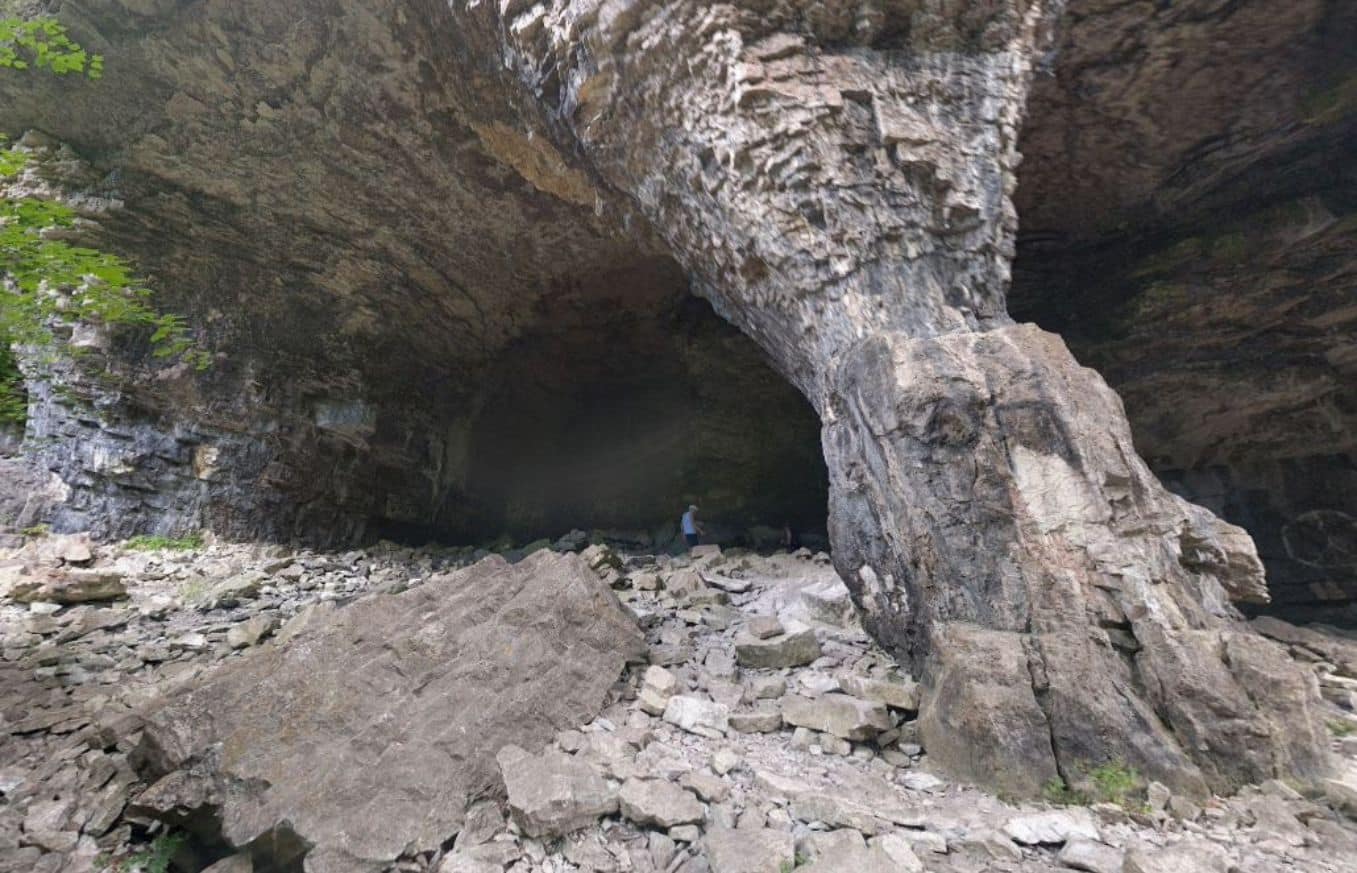
The Niagara Escarpment is a series of cliffs that stretch from New York State, through central Ontario to Manitoulin Island in the northwest, and then curves westward and south into Michigan. The cliffs are the exposed edge of layers of hard "dolostone" which resist erosion, formed as coral reefs in ancient tropical seas some 440 million years ago. Promontories like Lion's Head have been exposed to rough coastal waves for millenia which have undercut the cliffs into numerous caves.
For learning, curriculum, and digital storytelling to be guided by community input.

DEEP TIME’ is the themed expression of how exploring and understanding the past helps create a better future. The unique DEEP TIME story and its eight geological chapters encourages both visitors and residents to know the past, celebrate the present and help create a more resilient future for the Bay and its many communities.
2.7 billion years
Sault Ste Marie to Serpent River
The ancient mineral-rich rocks of the North Channel record the breakup of the planet’s oldest supercontinent – and the birth of the Huronian Ocean.
1.8 billion years
Serpent River to Killarney
The Group of Seven’s white rolling quartzite hills are the stumps of mountains formed when landmasses collided to form supercontinent Nuna
1.3 billion years
Killarney to Honey Harbour
The waterscape of the 30,000 Islands exposes the deep crustal roots of the immense Grenville Mountains formed when North and South America collided.
500 million years
Manitoulin Island
Much of North America was covered by warm shallow seas, teeming with early marine life that left fossil-rich limestones on Manitoulin Island.
350 million years
Tobermory to Wiarton
350 million years
Tobermory to Wiarton
13,000 years
Collingwood to Wiarton
The raised beaches of glacial Lake Algonquin surround the coast of southern Georgian Bay like staircases and hosted the camps of caribou-hunting Paleo-Indians 11,000 years ago.
Last 10,000 years
Collingwood to Honey Harbour
The ancient hard rocks of the Canadian Shield meet the softer limestones of the ancient seas creating a stark contrast in landscapes, ecosystems, and a diverse cultural history unique in North America.
4,000 years to today
Waters of Georgian Bay
In 1615 Samuel de Champlain called Georgian Bay ‘La Mer Douce’ (the sweet water sea). An early map also portrays it as Karegnondi, derived from ‘lake’ in the language of the Petun First Nation.