Learning Modules
The Georgian Bay Geopark is a portal to research and education that furthers study of our area’s unique geoology and supports our mission to encourage all to Explore the Geological Past and Create a Sustainable Future.
Modules
These educational modules were prepared as part of Ontario’s Virtual Learning Strategy Program, designed to support online learning in a university environment. They constitute part of a fully online course (including assessments) hosted within a Learning management system that can be accessed here.
Module 1
Overview of the Georgian Bay and the Case for Geoconservation
By the end of this lesson, you will be able to:
• Locate major land features of the Georgian Bay.
• Describe the basic geological structure of the Bay and how it relates to major physiographic and ecological divisions.
• Outline why the Georgian Bay is worthy of geoconservation.
Module 2
Geology Fundamentals
By the end of this lesson, you will be able to:
• Differentiate between the 'compositional' and 'mechanical' layers of the Earth and their properties.
• Explain how plate tectonics moves the continents around on Earth's surface.
• Refer to some of the common rock types in Georgian Bay and explain how they formed.
Module 3
The Paleoproterozoic Southern Province
By the end of this lesson, you will be able to:
• Demonstrate a full Wilson's cycle within the geologic record of the Southern Province.
• Interpret how climate change influenced the rock types found in the Huronian Supergroup.
• Outline the major events of the Paleoproterozoic.
Module 4
Rodinia and the Grenville Province
By the end of this lesson, you will be able to:
• Describe the plate tectonic situation of the formation of Rodinia.
• Understand how the Grenville Orogeny 'worked' and identify the parts of the Grenville Province.
• Link metamorphic rock types to geological processes.
Module 5
The Paleozoic Platform
By the end of this lesson, you will be able to:
• Differentiate between clastic and carbonate rocks and their paleoenvironmental significance.
• Outline major changes in the fossil record through the Paleozoic.
• Identify factors that influence the deposition of different sediment types.
Module 6
Glacial History of Georgian Bay
By the end of this lesson, you will be able to:
• Outline factors that cause glaciation and influence glacial flow.
• Use the geomorphological record to characterize the history of glacial activity.
• Compare glacial activity during the Pleistocene with the conditions of the Antarctic Glaciers today.
Module 7
Niagara Escarpment
By the end of this lesson, you will be able to:
• Trace the Niagara Escarpment from a topographic map.
• Describe a variety of processes that have shaped the Escarpment and the landforms that result.
• Outline the history of natural phenomenon shaping the Escarpment.
Module 8
The Holocene Of Georgian Bay
By the end of this lesson, you will be able to:
• Define terms relating to sediment remobilization and beach processes.
• Outline the history of the Penetang Peninsula and Wasaga Beach.
• Interpret the history of changing lake levels by observing landforms.
Interactive Education
The Geopark is making research available for all communities in the Bay. These are the first two in our publicly available library.
LiDAR mapping of glaciated bedrock surfaces
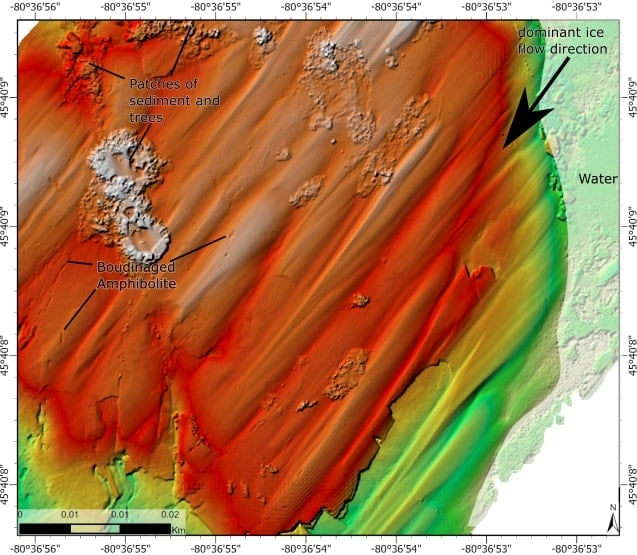
Recent advances in LiDAR collection technology are quickly revolutionizing numerous scientific fields, from glaciology to ecology to archaeology. By emitting millions of laser pulses and measuring their reflections, LiDAR produces highly accurate 3D maps that reveal subtle features across wide and often inaccessible landscapes.
The Gowganda Formation
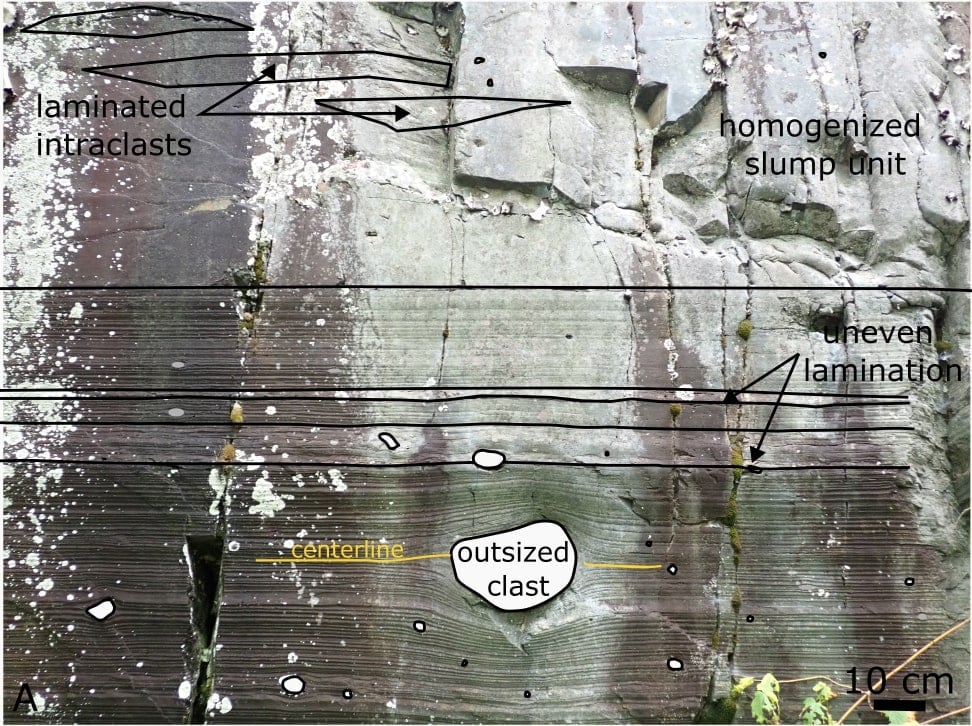
Across the North Shore of Lake Huron, and in the rugged La Cloche Mountains lies the Gowganda Formation — one of the world’s most remarkable records of an ancient ice age, more than 2 billion years old, a time period known as the Paleoproterozoic. These rocks formed on the floor of the long-vanished Huronian Ocean, which was surrounded by active fault scarps, large river systems, and dynamic glaciers.
See LIDAR images of Deep Time Zone 7: The Meeting Place
Discover the DEEP TIME geology of the Georgian Bay Geopark
DEEP TIME’ is the themed expression of how exploring and understanding the past helps create a better future. The unique DEEP TIME story and its eight geological chapters encourages both visitors and residents to know the past, celebrate the present and help create a more resilient future for the Bay and its many communities.
DEEP TIME Zone 1
The Huronian
Ocean
2.7 billion years
Sault Ste Marie to Serpent River
The ancient mineral-rich rocks of the North Channel record the breakup of the planet’s oldest supercontinent – and the birth of the Huronian Ocean.
DEEP TIME Zone 2
Continents
Collide
1.8 billion years
Serpent River to Killarney
The Group of Seven’s white rolling quartzite hills are the stumps of mountains formed when landmasses collided to form supercontinent Nuna
DEEP TIME Zone 3
The Ancient
Himalayas
1.3 billion years
Killarney to Honey Harbour
The waterscape of the 30,000 Islands exposes the deep crustal roots of the immense Grenville Mountains formed when North and South America collided.
DEEP TIME Zone 4
Tropical
Seas
500 million years
Manitoulin Island
Much of North America was covered by warm shallow seas, teeming with early marine life that left fossil-rich limestones on Manitoulin Island.
DEEP TIME Zone 5
The Limestone
Coast
350 million years
Tobermory to Wiarton
Within the last 2 million years, the Bruce/Saugeen peninsula was scoured by Ice Age ice sheets that cut deep valleys into the face of the Niagara Escarpment such as at Owen Sound.
DEEP TIME Zone 6
Ice Ages &
Early
Cultures
13,000 years
Collingwood to Wiarton
The raised beaches of glacial Lake Algonquin surround the coast of southern Georgian Bay like staircases and hosted the camps of caribou-hunting Paleo-Indians 11,000 years ago.
DEEP TIME Zone 7
The Meeting
Place
Last 10,000 years
Collingwood to Honey Harbour
The ancient hard rocks of the Canadian Shield meet the softer limestones of the ancient seas creating a stark contrast in landscapes, ecosystems, and a diverse cultural history unique in North America.
DEEP TIME Zone 8
Mindo Gami Great
Spirit Lake
4,000 years to today
Waters of Georgian Bay
In 1615 Samuel de Champlain called Georgian Bay ‘La Mer Douce’ (the sweet water sea). An early map also portrays it as Karegnondi, derived from ‘lake’ in the language of the Petun First Nation.